Showing posts with label Citrus Trees. Show all posts

Friday, April 28, 2017

A Gusty Spring

I've been really enjoying my growing plants this Spring. It has been really windy the past few days and the weather was a little cooler, which encouraged me to be outdoors trimming and giving other attention to my plants. Here are some photos of our backyard taken a few weeks back. The yard looks so different from when we moved in August of 2015. And I have plenty of dreams for it to look better in the next years, but I'm also practicing patience. It is so rewarding seeing plants grow into what I imagined when in the planning stages. I love how the view out my home windows improves with each season.


Tarocco Blood Orange Tree, planted Feb 2016


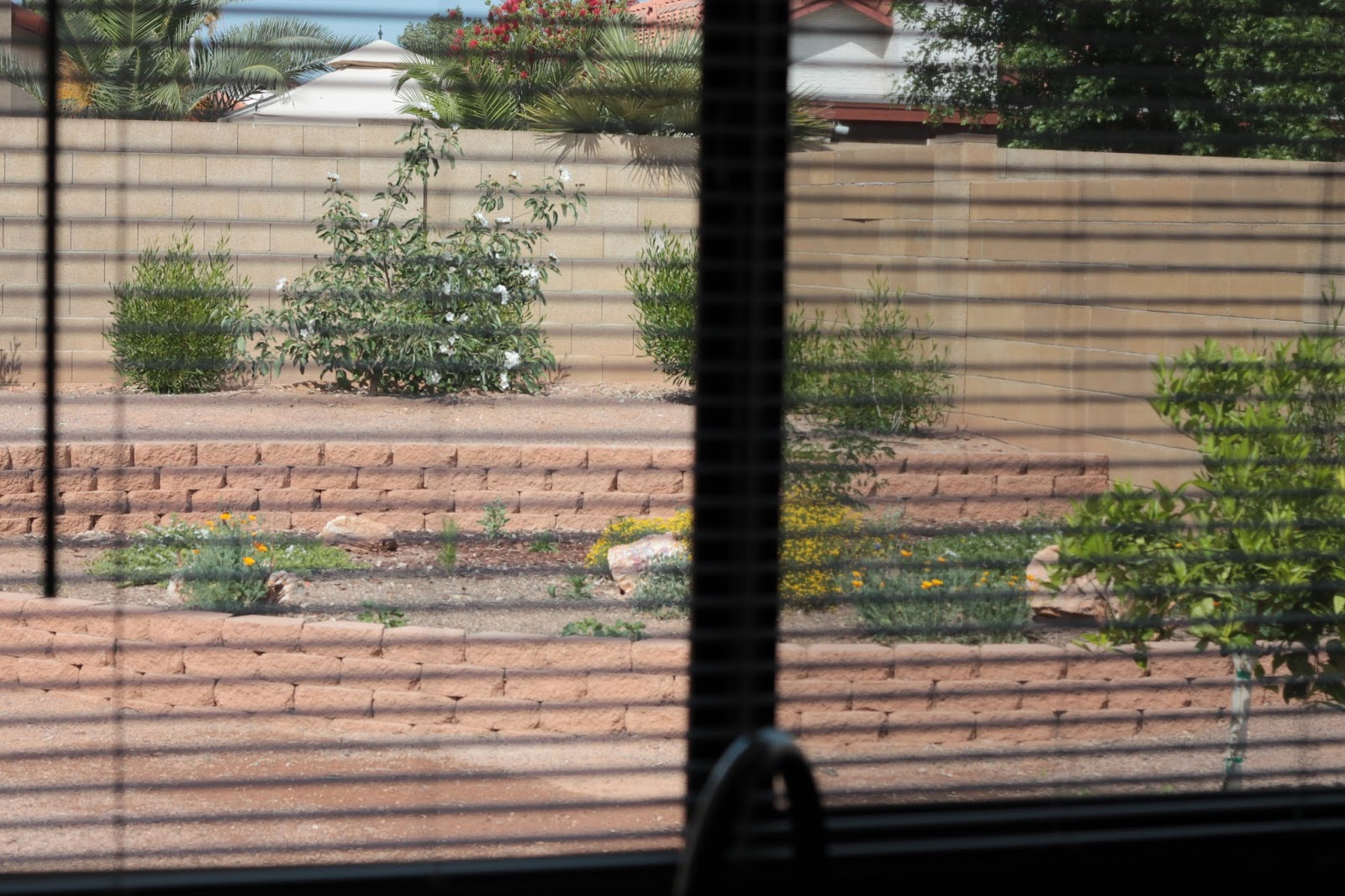
Improving view from my kitchen window

2 new hibiscus plants

Young volunteer basil plant I moved from another garden bed.

Flowering Green Onion

Armenian cucumber plants climbing, I supported them with some twisty ties. Compost behind.

Tiny cucumber forming

Luffa Squash seedling. First I soaked the luffa seeds 24 hours with no sprouting. Then I rubbed new seeds with fine sand paper and they sprouted! They required protection from birds.

Pole Green Beans. We'll see if they can share their trellis with the luffa squash plants. I'm anticipating them running out of space.

Yellow Bell Pepper plant, clustered blossoms in the center top of the small plant.

Patio tomato plant growing well in a large pot. I've been more diligent this season with fertilizing my garden, about every 2-3 weeks.

Cantaloupe (muskmelon) plants growing slowly

My beautiful Chaste Tree, growing fast, tripled original size since planting 1 year ago.

Chaste Tree blooms, bees are enjoying them.

Front yard, Young Desert Willow's first blooms this month. Planted Fall 2016, (Free SRP Shade Tree)

Desert Willow

Front yard, Chitalpa Tree, ruffly blooms. Trying to know how to prune this oddly-growing tree. It is growing toward the east side, so is lopsided. May need some staking to straiten it up.

Front yard, First time enjoying blooms (and new bright-green growth) on my wax leaf privet. When we moved in it was in bad health with overspray of herbicides (all the plants in the front yard were really bad looking, almost unrecognizable.)

Wax Leaf Privet


Monday, January 23, 2017

Our young Tarocco Blood Orange Tree

We purchased our Tarocco Blood Orange Tree at a 16" size (about 5 year-old) almost a year ago, February 15th 2016. Over that years time, we have been very cautious to follow all the instructions of planting, watering, fertilizing (only once in fall) that we received from Greenfield Citrus Nursery. We planted it directly into the native soil without any amendments. This was before we had clues that our soil had been treated with chemical herbicides that has been evident in stunted and deformed growth all over the yard. 
Although our citrus tree has grown new leaves over the past year, the overall size (height, width and trunk diameter) has not changed much and I am seeing mostly deformed or damaged foliage on the tree which has me concerned. I am hopeful that springtime will bring some healthy new growth for our tree and this upcoming year will be productive. I also hope to seek guidance from an expert and show them the images below.
Here are some detailed photos of how the tree looks currently.


UPDATED 2/9/2017
I called and emailed Greenfield Citrus Nursery about my concerns and here are the ideas I was given:

"The tree looks like it needs some fertilizer. Since you purchased the tree last year, you could add some fertilizer to the tree now. About 3 tablespoons should be sufficient for the amount. Apply the fertilizer at the edge of the drip line. Water the tree on its normal cycle, let the water soak in, then apply the fertilizer. Where is this tree planted? Is it near grass? Do you have a well for the tree about 3 feet wide? You need to have the well clear of rocks, weeds, and other plants. Do you still have the trunk covered with the cardboard to keep the tree from sunburning?

How do you water the tree? . The tree needs deep watered about once a week in the summer, and only about every 2-3 weeks in the winter. With a automatic system, how often does it get watered? This tree needs about 10-12 gallons a week in the summer, and about 6 gallons in the winter, every 2 weeks, altering for the weather, depending on rain or the warming trends we’re having. If the tree gets west and/or south sun during the majority of daylight, it would be good to make a shade screen to the west or south of the tree to help shade it during the summer. The small black spots on the leaves are mineral deposits from the water. Nothing to worry about. You have some curled leaves from “thrip”, which is a tiny insect that gets on the newer leaves of citrus and you “see” the cosmetic damage about 9 months later. You can spray the foliage in the spring and fall to lessen these bugs. Every citrus tree has some thrip leave change, but sometimes the cosmetic effect shows more. Triple Action Plus works well on killing the thrip insects.

Let us know if you have questions.
Thank you for sending the pictures.

Debbie @ Greenfield Citrus.

Greenfield Citrus Nursery
2558 E. Lehi Rd
Mesa, AZ 85213
480.830.8000
Greenfieldcitrus.com


HI Chelsea, next time you water the tree, check the soil moisture before you water again. I’m wondering if the soil is draining fast or slow. If the water is setting in the soil longer, then the roots aren’t drying out enough between watering. If the soil is dry between watering, then you may need to increase the watering frequency. Probe the soil with a long screwdriver out from the trunk about 8”, and then probe into the soil about 8” deep at that same point. If the soil is damp enough to hold itself into a ball in your fist, then wait longer until you water the next time. If the soil is dry and flaky when you probe, then the tree may need MORE water. Each area can have a different absorption rate, so it can be difficult to ascertain the tree’s needs. Hope this makes sense. "

Friday, March 18, 2016

My New Mesa Garden

Russian Desert Tortoise, Tana, below our newly planted red hibiscus

We moved in August of 2015, so we said goodbye to our growing plants at our old Mesa house and have begun to make our new land more beautiful with new life and the future plans of more gardens, both flowers, desert and vegetable/fruits. 
When we moved in, we had the following plants in the backyard; 2 African Sumac trees (removed Oct 2015), 1 Eucalyptus tree (trimmed Nov 2015), small cactus (removed Aug 2015) and a dark pink bougainvillea bush.
And in the front yard; honeysuckle bush, 2 lantana (orange and yellow), 2 aloe vera patches (1 removed), 2 sick sage bushes (trimmed back and recovering), 3 oleandar bushes (1 dead removed and 1 sick) and 1 beautiful evergreen bush near the front door that I haven't identified yet.

Our first addition to our backyard at the beginning of February was a retaining wall to maximize the usability of the land and correct the water flow of the yard. It was a big job and had to be done before any other plans could move forward. 
On February 13th 2016 we planted a 5 year-old Tarocco blood orange tree (purchased from Greenfield Citrus Nursery for $85) in a location where it will receive much of the rain water flow and will create a nice privacy screen many years from now. I wish it could just grow up faster!!! 

Tarocco Blood Orange Tree planting
 Since my garden space wasn't ready yet, my first vegetable planted was a roma tomato plant in a topsy-turvey planter given to us for Christmas. It has probably tripled in size since I planted it on Feb 15th 2016.


In the front yard, I added some low-water plants (1 gallon size, white lantana, morning glory, red yucca, agave, purple fountain grass, muhly grass, a 15 gal Chitalpa tree and a 15 gal Leatherleaf Acacia that I plan to prune into a small tree over many years).

agave, white lantana, morning glory and purple fountain grass

muhly grass, white lantana and red yucca
15 gal Pink Dawn Chitalpa Tree from Tree Land Nursery, planted March 11, 2016
15 gal Leatherleaf Acacia Tree from Treeland Nursery, planted March 11 2016
In the backyard, over the past several weeks, I have transplanted the following plants; 2 green hop bushes for privacy screening, sturts cassia bush for screening, red hibiscus bush, ruellia, white rain lilly grass, ice plant, 2 jojoba and elephant food cuttings.

2 green hop bushes
sturts cassia (senna)
hardy iceplant in bloom
red hibiscus
I also planted the seeds of poppies, zinnias and snapdragons in a large flower bed on February 19th after mixing in some aged horse manure into the native soil. They are growing slowly but steadily.
I planted nasturtium and alyssum (carpet of snow) seeds in various areas around for our tortoises. The tortoises have eaten each nasturtium leaf that has sprouted, so I'll have to cover them or plant again in a pot or garden box to let them get started. They devoured 5 purple heart cuttings I planted a few weeks back as well.

As for my vegetable garden, I decided to try something new and build garden boxes instead of planting at ground level like I have in the past. The benefits for me are to keep my kids (and their friends) from trampling newly planted seeds, to keep my tortoises out, to avoid needing to till into the current soil and amend it as well as to define my garden space.
My husband and I worked together to make two 3'x6' garden beds from 12 cedar picket fence boards and some scrap 2x4's. I painted them and we placed them in the higher tier of our yard where they get full sun. Since I got a late start for the Spring season and the weather has been very warm, I decided to just sew some carrots, green onion (both from seed and from store-purchased onion roots) and basil. My kids also planted marigolds and carrots in their own garden boxes made from hollow-centered cement blocks. 


The 2nd garden box is currently being used as my compost pile with a mixture of aged horse manure, wood and leaves from a landscaper's chipper, kitchen scraps including egg shells, a small amount of wood ashes and native soil. 
I'm excited to expand the garden space with more raised garden beds in future seasons as well as some in-ground garden space for large growers like corn. I also hope to get a permanent composting solution for our yard.

I am learning patience as I wait for all my little plants to grow and for my yard to be more beautiful and producing. I will try to record what I learn now that I am back into my Mesa Gardening again! 


Tuesday, September 30, 2014

Replanting Seeds, Flooding & Growth

In the past few weeks, very few of my planted seeds grew, maybe I let them dry out, I didn't think so. The cabbage and green beans grew fine.
So I re-planted lettuce, spinach, cilantro, green onion and peas. I planted my tomato transplants as well as a purchased cherry tomato plant. I also planted zucchini and carrots, but that same day the heavy rains came (Sept 27th) so I'm not sure how the seeds will handle the flooding. We have had record breaking rains this September and the citrus trees are happy, but the gardening has been tricky. Cats pooping in my garden has also caused me some frustration. With my garden area larger than previous years, I don't have netting large enough to cover it all and keep them out.
My compost has some lovely plants growing with yellow flowers.
Today I planted Marigold seeds in two sections of the garden. The estimated days until bloom 30-50 days. We'll see how they grow!
Our family is getting excited as our citrus grows larger, we know that citrus time is only a few months away!
Here's how our backyard is looking.

Bush Beans


Compost Pile

Grapefruit